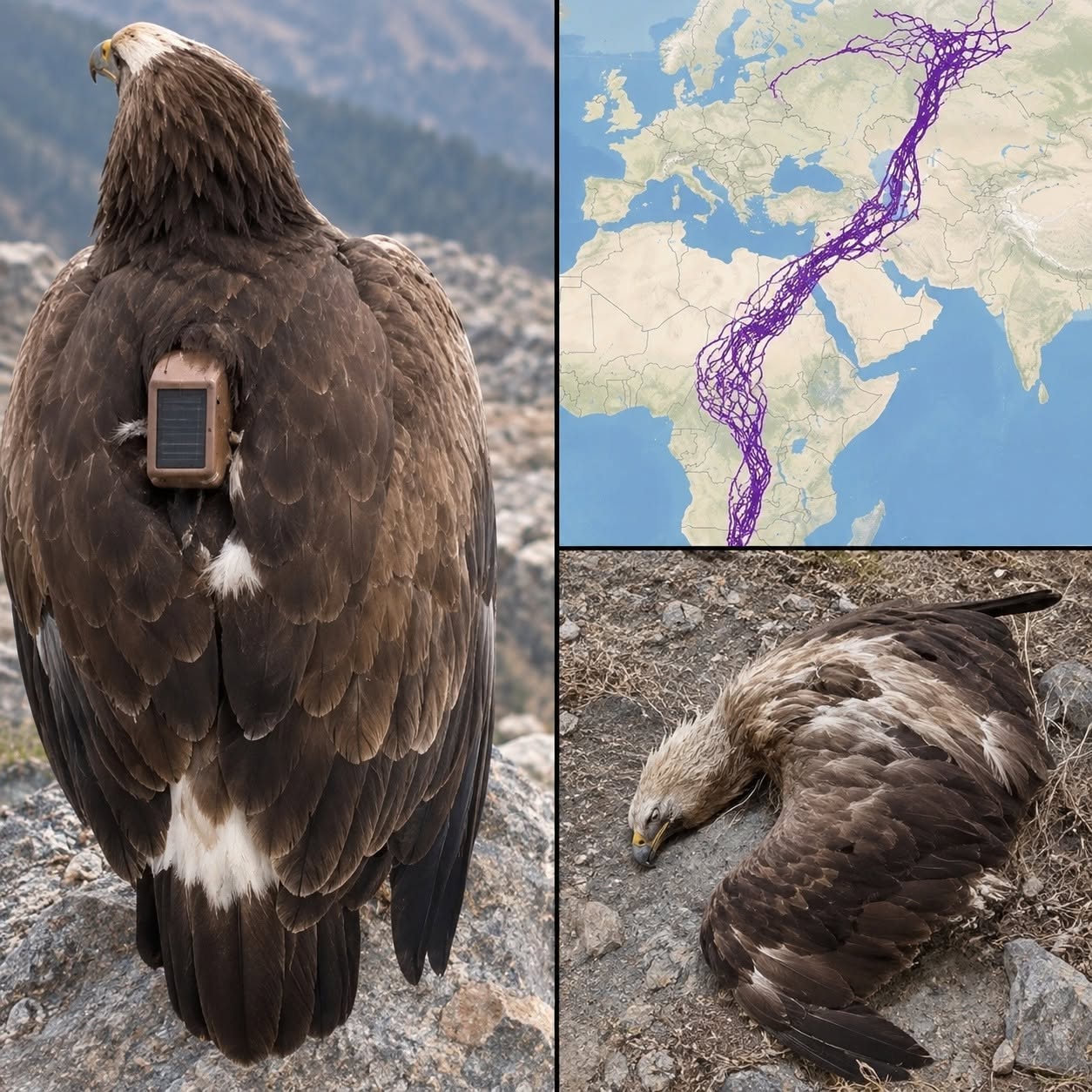
The first is shorter but requires a bird to fly against strong winds, cross a wide stretch of water, and spend long periods flapping its wings.
The second is longer but passes through areas where rising air provides lift and suitable feeding or resting opportunities may be available.
For a large soaring bird, the longer route may sometimes be more economical.
Eagles and other soaring raptors are especially influenced by the atmosphere.
Rather than relying entirely on continuous wingbeats, many of these birds use naturally occurring air currents to remain aloft.
Warm air rising from the ground can form columns known as thermals.
When an eagle finds one, it may circle upward, gaining altitude while conserving energy. Once sufficiently high, it can glide forward until another useful current becomes available.
In mountainous regions, wind striking a slope can also create rising air.
This phenomenon, known as orographic lift, provides another opportunity for soaring birds to gain or maintain altitude.
These invisible features of the atmosphere help explain why eagle migration routes can differ from the paths people might choose when looking at a map.
A scientific study of migrating golden eagles demonstrated that the birds adjusted their use of thermal and slope-generated lift in response to changing wind conditions.
The study involved ten tracked golden eagles, not a single bird monitored for twenty years, and it provided evidence of highly responsive flight behavior.
PMC+1
The important lesson is that birds do not travel through a passive environment.
The atmosphere is constantly moving.
And a skilled soaring bird must respond to that movement.
A route that appears indirect from the ground may make sense when viewed through the conditions experienced in flight.
Mapping a Lifetime of Flight
Mapping eagle migration routesMigration map illustrationEagle migration tracking
The Invisible Highways Above the Earth
Human beings tend to think of geography in terms of visible objects.
We recognize rivers, mountain ranges, highways, deserts, and oceans.
But for migrating birds, some of the most important features of the landscape cannot be seen.
Air itself becomes a kind of highway.
A thermal rising above sun-warmed terrain can provide temporary support. A mountain ridge can create a predictable area of uplift. A favorable tailwind may increase the distance a bird can cover while using less energy.
These atmospheric conditions influence not only the direction of travel but also the timing.
An eagle may benefit from waiting until conditions improve rather than immediately continuing its journey.
On another day, favorable weather may allow it to travel much farther.
Migration therefore involves a combination of movement and restraint.
Knowing when to continue can be as important as being physically capable of flying.
Scientific research into raptor movement repeatedly demonstrates the importance of wind and geography.
One study examining grey-faced buzzards migrating through East Asia found that islands and favorable winds helped shape their oceanic migration routes.
The birds crossed stretches of open water that could reach hundreds of kilometers, showing how geographical stepping stones and atmospheric support can work together.
PMC
Although buzzards and eagles are different birds, research of this kind helps scientists understand broader principles affecting soaring migrants.
It also explains why a seemingly strange bend in a flight path might be perfectly understandable once the relevant environmental information is included.
What appears to be a detour may be part of an energy-saving strategy.
What appears to be hesitation may reflect the conditions needed for a safer crossing.
And what seems to be a completely unexpected destination may provide resources that are invisible on a conventional map.
Why Oceans Can Become Enormous Obstacles
Consider a large eagle approaching the edge of a coastline.
Beyond the shore lies an expanse of water.
To a human observer, flying across it may appear straightforward. Birds have wings, after all.
But the physics of flight makes the situation more complicated.
Many large raptors depend heavily on rising air over land.
Warm ground surfaces produce atmospheric conditions that often support thermal soaring. Over broad stretches of water, particularly cooler seas, such thermal support may be weaker or less dependable.
Consequently, certain soaring birds tend to avoid unnecessarily long water crossings.
Some migration routes become concentrated around narrow straits or land bridges where birds can cross with reduced exposure to unfavorable conditions.
This can create spectacular gatherings of migrating raptors.
A geographical feature that might look like a minor detail to humans can become critically important to thousands of birds moving between seasonal habitats.
Researchers have documented the influence of winds on eagle migration near the Strait of Gibraltar, highlighting how different raptor species respond differently to challenging conditions.
iris.polito.it
Yet the ocean is not an absolute barrier.
Some birds are capable of remarkable long-distance crossings.
Research on migrating ospreys found that these birds could exploit thermal uplift even over sections of open sea, although the conditions differed from those over land.
PMC
The lesson is not that all birds follow the same method.
Quite the opposite.
Different species possess different physical abilities and migration strategies.
Even within a species, individual circumstances can influence movement.
The sky is not a uniform surface, and every journey presents a changing collection of opportunities and risks.
How Weather Can Rewrite a Migration Route
If migration were controlled by a perfectly fixed internal schedule, researchers might expect birds to follow nearly identical paths regardless of conditions.
But real environments are too variable for such a simple picture.
One season may bring favorable winds.
Another may bring repeated storms, unusual temperatures, or dry conditions that change the availability of food.
Even within a single day, the atmosphere may behave differently from what a bird experienced hours earlier.
A soaring eagle traveling across a mountain region may encounter strong upward winds on one slope and less favorable conditions on another.
A broad weather system may encourage movement in a different direction.
Poor conditions may force an extended stop.
When researchers examine migration data, these changing circumstances matter enormously.
It is tempting to describe every unusual turn as evidence that a bird made a brilliant decision.
However, science requires more careful interpretation.
Some movement changes may reflect active behavioral adjustments, while others may result partly from wind drift or other physical influences.
Scientists investigate these possibilities by comparing recorded locations with weather data, flight characteristics, and habitat conditions.
The complexity is precisely what makes this research fascinating.
Migration is not merely a question of knowing where to go.
It is also a continuous interaction between an animal and its surroundings.