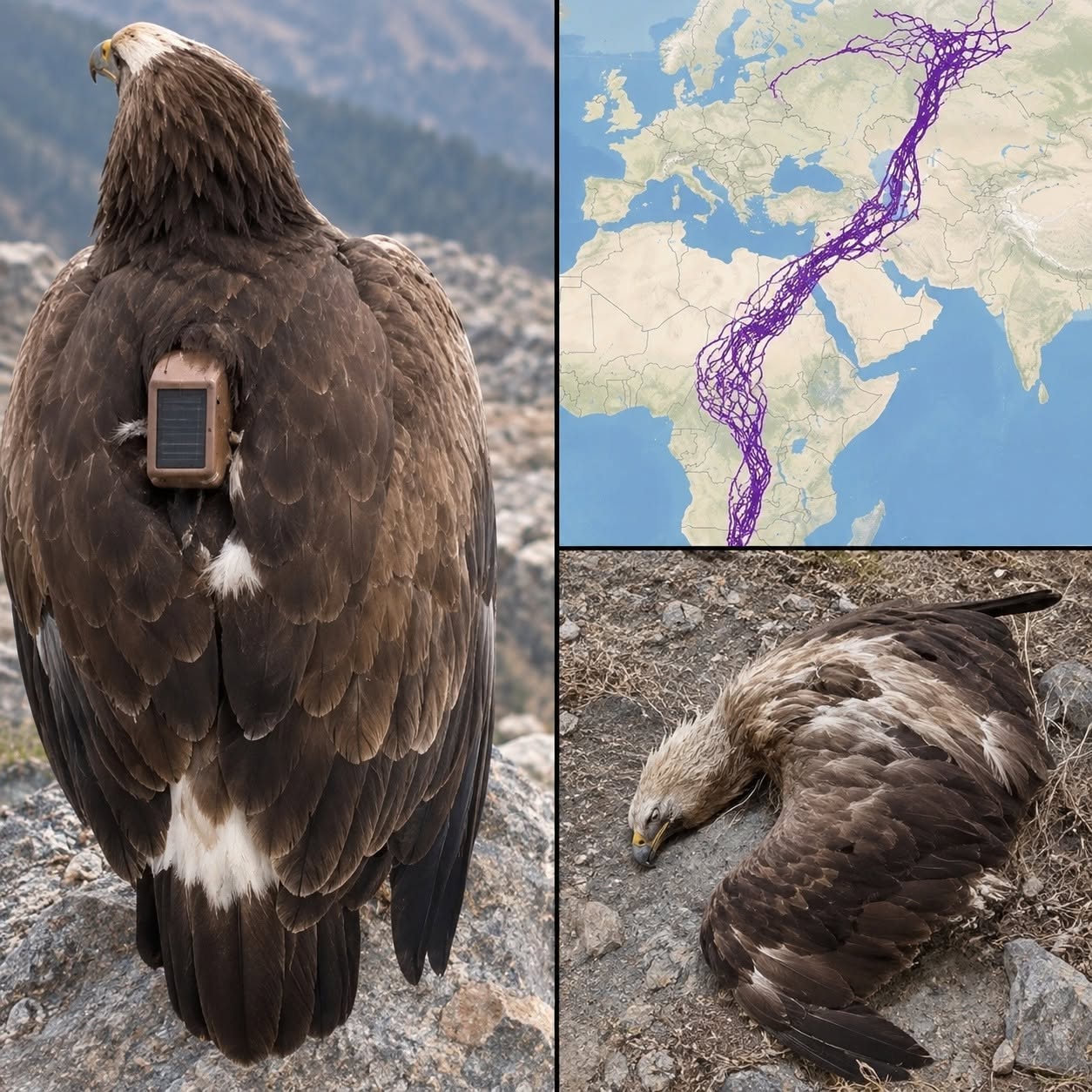
The bird brings its abilities and behavioral tendencies.
The environment supplies changing constraints.
And the final route emerges from the interaction between the two.
The Importance of Food Along the Way
Long-distance travel requires energy.
For a migrating eagle, finding suitable food can affect its condition and its ability to continue moving.
Different eagle species have different diets and hunting strategies. Some take live prey, while others may make extensive use of carrion or other available food resources.
These differences influence how birds interact with the landscapes they cross.
A productive hunting area may provide an opportunity to replenish energy reserves.
A region that appears empty on a map may contain prey or other resources during a particular season.
Conversely, an area that provided suitable conditions in one year may become less productive following drought, habitat changes, or other environmental disturbances.
Scientists studying movement patterns therefore often consider the ecological characteristics of areas where tracked birds spend time.
A pause in travel may be associated with feeding.
But researchers must be cautious about assuming that every stop has one obvious explanation.
A bird might also be resting, avoiding unfavorable weather, or engaging in behavior that cannot be determined from location data alone.
This uncertainty does not diminish the value of tracking research.
Instead, it reminds us that a GPS location is a clue rather than a complete account of an animal’s experience.
Understanding migration requires connecting those clues with the broader ecology of the species.
Why Mountains and Deserts Shape Migration
Mountains and deserts often appear as dramatic features on maps of bird migration.
They can also create very different challenges.
Mountain ranges may offer useful rising air along certain slopes, but they can expose birds to difficult winds, severe weather, and high elevations.
Deserts may offer wide open spaces and strong thermal conditions while presenting challenges related to food availability, heat, and places to rest.
A migrating bird moving through such environments must contend with multiple pressures.
The shortest geographical distance may involve crossing an area where conditions are demanding.
An alternative route may be longer but pass through more favorable terrain.
For example, research involving migratory raptors crossing the Himalayan region has shown how geography and prevailing winds can help explain routes that might otherwise seem surprising.
Scientific Reports
The mountain landscape becomes more than an obstacle.
It becomes part of the decision-making environment.
Wind direction, elevation, and the arrangement of suitable habitat all contribute to the journeys scientists observe.
This is one reason migration maps are so valuable.
They allow researchers to examine where movement corridors intersect with difficult natural terrain.
They can also reveal areas that may deserve greater attention because of their importance to traveling birds.
A remote mountain passage or a relatively narrow stretch of land may play an outsized role in the survival of a migrating population.
The Difference Between Instinct and Learning
One of the most interesting questions in migration science concerns how birds know where to go.
Migration involves biological mechanisms that have developed over many generations.
Inherited tendencies can influence the timing and direction of seasonal movement.
But behavior is not necessarily limited to a rigid set of instructions.
For some birds, experience can also play a role.
An individual may encounter different conditions as it matures. Its future movements may reflect not only inherited behavior but also information gained through earlier journeys.
Scientists study such questions by comparing birds of different ages and examining repeated journeys by the same individuals when suitable tracking data are available.
Research involving Eastern Imperial Eagles in Central Asia has documented differences in movement patterns between an adult and younger tracked birds, including more efficient travel by the adult in that study.
U.S. Geological Survey
This does not prove that every difference was caused by learning.
Experience, physical development, environmental conditions, and individual variation may all contribute.
Nevertheless, the findings help reveal the complexity of migration.
A young bird encountering unfamiliar terrain may face a very different challenge from an experienced adult returning to regions it has visited before.
Migration can involve both inherited biological tendencies and behavior shaped by circumstances.
It is neither a completely automatic process nor necessarily a series of fully conscious choices.
The reality is more interesting than either extreme.
Can Birds Really Make Decisions While Flying?
When people see complicated migration routes, they often describe the birds as intelligent.
There is good reason to admire their abilities.
A bird traveling across thousands of miles must coordinate movement, orientation, energy expenditure, and responses to changing conditions.
But scientific language matters.
Researchers distinguish among instinctive behavior, sensory responses, learning, flexible behavior, and different forms of cognition.
Not every successful adjustment proves deliberate planning in the human sense.
A bird may change its flight pattern because of immediate atmospheric conditions without mentally calculating a complete route.
On the other hand, repeated successful movement through complicated environments may involve memory, experience, and sophisticated behavioral abilities.
Scientists continue investigating how different species integrate information.
The most important point is that animals are not merely passive objects being carried across the planet.
Their behavior interacts dynamically with environmental conditions.
They respond to opportunities and constraints, and their movements can be remarkably effective.
Calling this process simply instinct may overlook its complexity.
Calling every maneuver conscious strategy may go beyond the evidence.
The challenge for researchers is to understand the mechanisms as precisely as possible.
That challenge has produced some of the most exciting developments in modern movement ecology.
When a Map Tells Only Half the Story
Imagine looking at a migration map covered with hundreds of lines.
It may be tempting to find the most unusual-looking section and build a dramatic explanation around it.
Perhaps a bird seemed to reverse direction.
Perhaps its route passed near the same location several times.
Perhaps it avoided a major geographical feature.
But a map usually cannot reveal every relevant detail.
Its appearance depends on the number of birds included, how often their positions were recorded, the dates covered, and the way the data were displayed.
Combining tracks from many individuals can create a complex picture that resembles the travels of one exceptionally restless animal.
That was an important issue with the viral map described as a single eagle’s twenty-year journey.
The circulating story was misleading because it confused the movements of multiple eagles with the lifetime travel of one bird.
The real tracking work was still scientifically meaningful, but its interpretation changed dramatically when the correct context was restored.