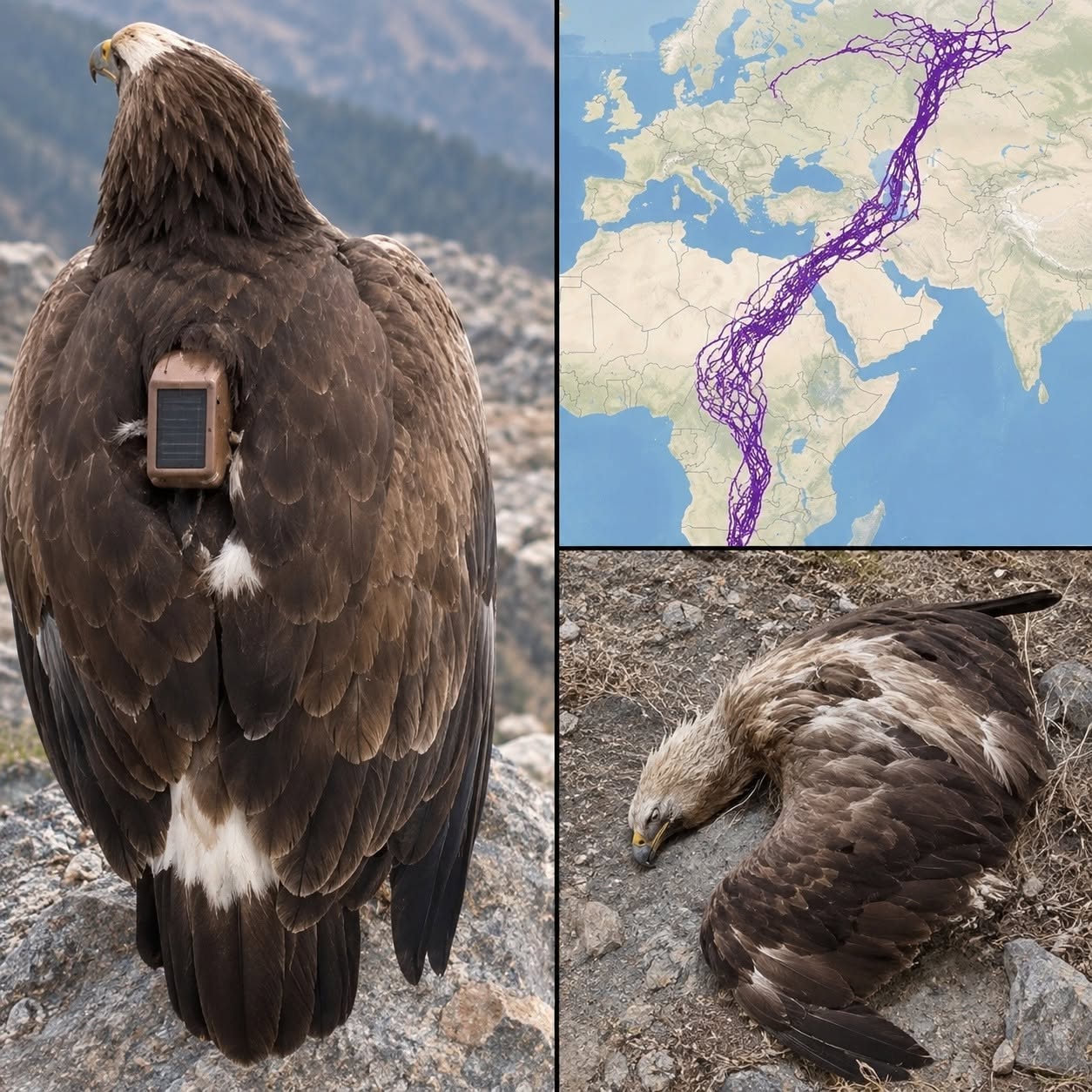
This offers a broader lesson about wildlife stories shared online.
Extraordinary images do not always require extraordinary explanations.
Sometimes the truth is already fascinating enough.
A group of eagles moving through enormous geographical regions is a remarkable subject without adding an unsupported twenty-year timeline.
And the scientific insights are more valuable when the original observations are described accurately.
Lessons From a Master Navigator
Eagle soaring illustrationEagle habitat and migrationEagle flight and conservation
Why Migration Research Matters More Than Ever
Understanding bird movement is not simply a matter of satisfying human curiosity.
The information can have major conservation implications.
Migrating birds may depend on a network of habitats spread across several countries.
Their breeding areas may be protected, but that protection alone may not be sufficient if important feeding grounds or movement corridors are threatened elsewhere.
A bird that travels enormous distances encounters many different landscapes and forms of human activity.
Some of these environments are changing rapidly.
Habitat loss can reduce access to suitable resting or feeding areas.
Changes in land use can alter prey availability.
Power infrastructure and other developments can introduce collision or electrocution hazards for some raptor species.
Climate change may influence seasonal weather patterns, habitat conditions, and the availability of resources.
The consequences vary considerably between species and regions, but the overall challenge is clear.
A migratory animal depends on more than one location.
Its survival may be connected to environmental conditions across a very large geographical area.
Tracking data help scientists identify where birds spend time, which corridors they use, and where they may encounter particular risks.
Such information can inform conservation planning, environmental assessments, and international cooperation.
In some cases, protecting a relatively small but strategically important region may benefit birds traveling across an entire continent.
This is one of the most powerful contributions of modern wildlife tracking.
It turns invisible journeys into information that people can use to make better decisions about conservation.
The Unexpected Connection Between Migration and Climate Change
Climate change introduces another layer of complexity to the study of migration.
Seasonal conditions are important to many migratory species.
Temperature, rainfall, wind, and food availability can all influence when and where suitable conditions occur.
When these environmental patterns change, the challenges encountered by birds may change as well.
Some species may be capable of adjusting aspects of their behavior.
Others may be constrained by breeding requirements, habitat needs, or established seasonal patterns.
Behavioral flexibility can sometimes help animals respond to new conditions, but it should not be mistaken for immunity to environmental change.
An eagle may adjust a flight route in response to wind, yet still depend on suitable breeding habitat and sufficient food.
Even highly mobile species cannot simply overcome every ecological disruption by traveling farther.
This is why migration research is so valuable.
Long-term observations, reliable tracking records, and environmental data can help researchers investigate whether movement patterns are changing over time.
Scientists can explore shifts in seasonal timing, differences in habitat use, or altered responses to weather.
But understanding these changes requires careful comparisons.
A single unusual journey does not automatically demonstrate a climate-related trend.
Researchers need sufficient evidence to distinguish normal variation from persistent environmental effects.
The more accurately scientists understand migration today, the better equipped they become to recognize meaningful changes in the future.
A Bird’s Journey Can Connect Entire Ecosystems
One of the most remarkable aspects of migration is the way it connects distant places.
A single bird may depend on landscapes that appear completely unrelated to one another.
A northern breeding region, a mountain passage, an agricultural landscape, a desert-edge feeding area, and a distant wintering ground may all form part of its annual life cycle.
To humans, these places may belong to different countries, cultures, and political systems.
To the migrating animal, they are connected through the physical requirements of survival.
This perspective changes how we think about conservation.
Protecting nature cannot always be accomplished by drawing a boundary around one beautiful landscape.
For migratory species, the connections between locations may be just as important as the locations themselves.
A region that seems unremarkable may provide seasonal resources at a critical moment.
A narrow passage may allow birds to avoid a dangerous crossing.
A protected habitat in one country may support animals that spend much of the year elsewhere.
Migration shows that ecosystems are linked through movement.
It also reminds us that animals experience the planet differently from humans.
Political boundaries may matter enormously to people, but an eagle is responding to geography, weather, habitat, and biological needs.
Its journey can cross borders without recognizing them.
The responsibility for protecting migratory wildlife, however, often requires cooperation between the people living on both sides.
What Technology Still Cannot Tell Us
Despite the remarkable progress of GPS tracking, there are limits to what scientists can learn from location data alone.
A device may show that an eagle traveled a particular distance.
It may reveal changes in speed and direction.
It may even help researchers identify likely soaring behavior when suitable measurements are available.
But the data do not provide direct access to the bird’s thoughts.
They cannot automatically explain every pause, detour, or change in direction.
To investigate those questions, researchers may combine tracking with behavioral observations, environmental measurements, ecological surveys, and statistical models.
Sometimes the evidence supports a strong conclusion.
At other times, several explanations remain possible.
This uncertainty is not a weakness of science.
It is part of the process through which scientific understanding improves.
The original eagle migration story became popular because the routes looked mysterious.
Yet a carefully researched explanation can be just as extraordinary as the mystery itself.
Wind patterns, energy conservation, feeding opportunities, habitat conditions, and individual differences can interact to create routes that are difficult to predict from a simple map.
The movements become more understandable when the relevant ecological information is added.
Even then, nature retains unanswered questions.
Every new set of reliable observations can reveal something researchers had not fully appreciated before.
The Value of Looking Beyond First Impressions
There is a broader lesson hidden within the complicated lines of a migration map.
Human beings often search for simple patterns.
We expect direct routes, familiar routines, and clear explanations.
When something seems to violate those expectations, we may assume it is chaotic or irrational.
But complexity is not the same as disorder.
A route that appears confusing on a two-dimensional map may reflect perfectly understandable responses to conditions that the map does not display.