A pause that looks unimportant may be associated with food or weather.
A long detour may help avoid a demanding natural obstacle.
What we see depends on the information available to us.
This principle reaches far beyond migration research.
Natural systems often involve relationships that are difficult to recognize without careful observation.
A change in one part of an ecosystem can influence another.
Weather can affect animal movement.
Animal movement can connect habitats.
Habitat conditions can shape survival and reproduction.
Understanding these relationships requires patience and a willingness to question first impressions.
The eagle migration map became famous because it offered an unexpected view of a familiar creature.
But its deeper significance comes from the scientific effort to interpret that view accurately.
The Quiet Strength of Adaptation
There is something profoundly moving about imagining a wild eagle traveling across an immense landscape.
It does not possess the protective infrastructure that humans rely upon.
There are no airports arranged for its convenience, no weather forecasts displayed before its eyes, and no guaranteed places to stop.
Its journey depends on physical adaptations, sensory abilities, behavioral patterns, and environmental conditions shaped by natural processes.
Sometimes those conditions are favorable.
Sometimes they are demanding.
Successful migration requires an animal to function within this changing world.
The ability to respond flexibly can be valuable, although each species has its own limitations.
For humans, the image of an eagle adjusting its route offers a powerful metaphor.
Progress does not always resemble a straight line.
Sometimes reaching a destination requires changing direction, responding to circumstances, or using resources that were not obvious at the beginning.
But the biological reality deserves appreciation independently of the metaphor.
An eagle’s movements are not designed to teach human beings life lessons.
They are part of the animal’s natural history.
And that natural history is remarkable enough to inspire wonder.
Why We Should Protect the Paths We Cannot See
Most people will never witness the full migration of an eagle.
They may see one soaring over a field or disappearing beyond a mountain ridge.
They may visit a nature reserve and glimpse a bird passing overhead.
What they cannot see is the immense geographical network that may connect that moment to distant places.
Tracking technology reveals those hidden connections.
It shows that protecting migratory wildlife requires thinking on a larger scale.
A healthy breeding site is important.
So are the habitats encountered during travel and the conditions at seasonal destinations.
Where research identifies serious threats, conservation efforts can become more targeted.
This may involve protecting important habitats, reducing risks associated with human infrastructure, or improving cooperation across borders.
Not every problem has a simple solution.
But reliable scientific information gives conservation planners a stronger foundation for action.
The more we understand about animal movement, the less likely we are to overlook areas that matter.
And the more carefully we verify extraordinary wildlife claims, the more clearly genuine scientific discoveries can receive the attention they deserve.
The Bigger Picture: Nature Is More Connected Than We Imagine
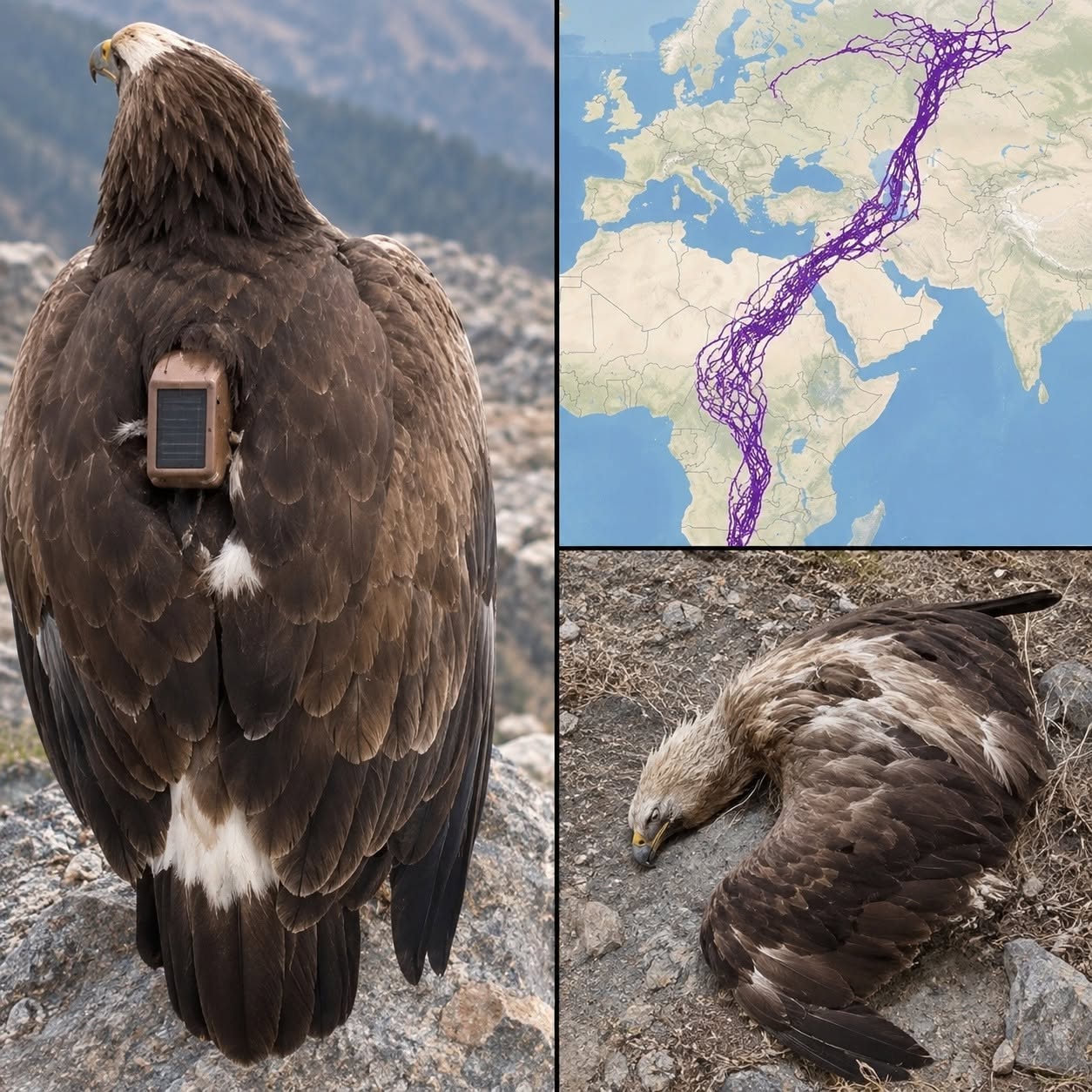
The story of the eagle migration map began with a striking visual mystery.
A network of complicated lines appeared to show an extraordinary journey across continents.
The popular explanation exaggerated what the original data represented.
Yet correcting that claim does not make the underlying science less impressive.
In many ways, it makes the story more meaningful.
Instead of imagining one bird traveling unpredictably for twenty years, we can appreciate the movements of multiple wild eagles and the ecological questions raised by their journeys.
We can recognize how wind, topography, food, weather, and experience may influence migration.
We can understand why the easiest route through the atmosphere may not be the shortest line on a map.
And we can see how modern tracking helps scientists connect individual movements to broader conservation challenges.
Perhaps the most important discovery is not that eagles behave in ways humans find mysterious.
It is that their behavior belongs to a remarkably complicated natural system that we are only beginning to understand in detail.
A soaring bird may appear small against the open sky.
Its connection to the world is anything but small.
The conditions beneath its wings may have developed hundreds of miles away. The habitats it depends upon may be separated by deserts, mountains, seas, and national borders. Its successful journey may rely on a combination of biological abilities and environmental opportunities that people on the ground never notice.
Every movement reveals another piece of this connection.
And every carefully interpreted tracking record offers an opportunity to understand it better.
Final Thoughts: The Most Extraordinary Truth Was Already in the Sky
The appeal of the famous eagle migration story is easy to understand.
People are drawn to extraordinary journeys, unexpected discoveries, and the idea that nature contains secrets hidden in plain sight.
A bird crossing immense distances without a human-made map seems almost impossible when considered from our everyday perspective.
Yet such journeys are real.
Across the planet, migratory birds navigate environments that can change dramatically from one day to the next.
They encounter shifting winds, difficult terrain, seasonal variations, and natural barriers.
Their movements reflect the astonishing relationship between living creatures and the world around them.
The lesson from eagle tracking research is not that science has discovered an animal capable of ignoring every rule.
It is that the rules governing natural movement are more complex than they first appear.
And sometimes, the most valuable discovery begins when researchers recognize that a familiar explanation is incomplete.
A line on a map is more than a record of distance.
It represents an animal moving through a living, changing environment.
Behind each curve may be a different combination of weather, geography, and biological behavior.
Behind every completed migration lies a remarkable natural process.
In the end, the greatest wonder is not that an eagle could travel so far. It is that the sky, the land, and the living world are connected in ways we are still learning to see.
Scientific references
The expanded article draws on published research about raptor migration, atmospheric conditions, satellite tracking, and conservation:
U.S. Geological Survey — Movements and Landscape Use of Eastern Imperial Eagles in Central Asia.
Flight Responses by a Migratory Soaring Raptor to Changing Meteorological Conditions.
Raptor Migration in an Oceanic Flyway: Wind and Geography Shape Migratory Routes.
Scientific Reports — GPS Telemetry and High-Elevation Raptor Migration.
Fact Crescendo — Verification of the Viral Eagle Migration Map.